On this page
What a chimney rebuild involves
A chimney rebuild means taking down damaged brick or block and laying new masonry in its place. It is different from repair work like tuckpointing or replacing a few spalled bricks, which fix the surface of a chimney that is still structurally sound. A rebuild is for when the masonry itself has failed: bricks are loose, mortar has washed out deep into the joints, or the stack has started to lean.
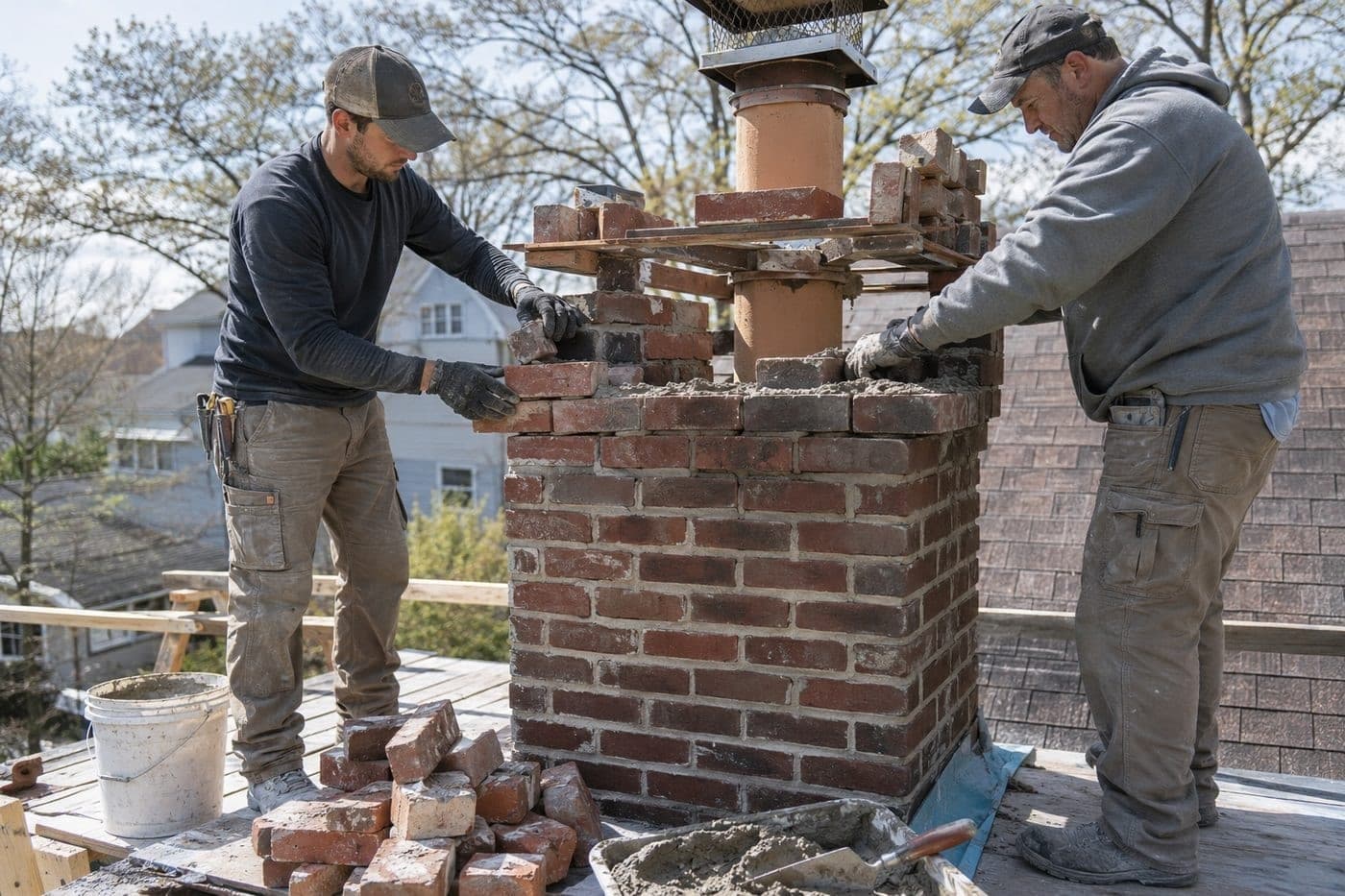
Most rebuilds are partial. The section above the roofline takes the most weather, so that is usually where damage concentrates. That part is taken down to solid courses and rebuilt. A full masonry rebuild, down to the roof or lower, is for chimneys where the damage runs deeper. If you are still weighing which one your chimney needs, our guide to chimney repair vs rebuild walks through the difference.
Signs a chimney needs rebuilding rather than repair
No single symptom decides it. Several of these together, or any one of them that is severe, usually point toward a rebuild:
Signs worth getting checked
- The chimney visibly leans or pulls away from the house or roofline
- Bricks that move when touched, or bricks and mortar pieces found on the roof or ground
- Mortar joints eroded so deeply that bricks sit loose in their beds
- Cracks running through the bricks themselves, not just the mortar joints
- Spalling, where brick faces are flaking or popping off, across a large area
- A crown that is broken apart, with water getting into the top of the stack
- Leaks around the chimney that keep coming back after repairs
A leak on its own often has a simpler cause, such as failed flashing or a cracked crown. Before assuming the brick is the problem, it helps to know how chimney leak repair works.
Leaning chimney repair
A leaning chimney is one of the clearest reasons to rebuild, and it needs attention sooner rather than later. A stack that has moved out of plumb puts uneven weight on its lower courses, and it can keep moving. Loose masonry at height is a falling hazard for anyone below.
A leaning masonry chimney generally can't be pushed back into position. The usual fix is to take the leaning section down to masonry that is still sound and plumb, then rebuild it straight. If the lean starts lower down, the cause may be below the roofline, so we look at where the movement begins before recommending how far down the rebuild needs to go.
If your chimney is leaning
Stop using the fireplace and keep people away from the area below the chimney until it has been checked. Loose brick can fall without warning.
Partial rebuild or full masonry rebuild
| Feature | Partial rebuild | Full masonry rebuild |
|---|---|---|
| Typical situation | Damage concentrated in the upper courses or above the roofline | Damage, movement or deterioration running through most of the stack |
| What comes down | The damaged section, down to sound masonry | Most or all of the chimney masonry |
| What stays | The solid lower portion of the chimney | Little of the original masonry |
| Finished with | New crown, flashing and cap | New crown, flashing and cap |
Typical situation
- Partial rebuild
- Damage concentrated in the upper courses or above the roofline
- Full masonry rebuild
- Damage, movement or deterioration running through most of the stack
What comes down
- Partial rebuild
- The damaged section, down to sound masonry
- Full masonry rebuild
- Most or all of the chimney masonry
What stays
- Partial rebuild
- The solid lower portion of the chimney
- Full masonry rebuild
- Little of the original masonry
Finished with
- Partial rebuild
- New crown, flashing and cap
- Full masonry rebuild
- New crown, flashing and cap
Rebuilding the crown with the stack
The crown is the concrete or mortar slab that seals the top of the chimney around the flue. When the upper courses are rebuilt, the crown is rebuilt with them, because there is nothing left to set the old one on. A properly shaped crown sheds water away from the brick, so it protects the new masonry from the start.
What happens on a rebuild job, step by step
From first visit to finished chimney
Inspection and assessment
We look at the chimney from the roof and from the fireplace side, checking how loose the masonry is, where any lean begins, and the condition of the crown, flashing and flue.
Free estimate
We explain what needs rebuilding and why: a partial or full rebuild, or a repair if a rebuild isn't needed.
Protecting the home
Roof surfaces and the area around the chimney are protected before any brick comes down.
Taking down damaged masonry
The failed section is removed course by course until we reach solid, plumb masonry to build on.
Rebuilding the stack
New brick and mortar are laid back up to the proper height, with the flue kept clear and aligned.
Crown, flashing and cap
The top is sealed with a new crown, the roof-to-chimney joint is flashed, and a cap goes on to keep out rain and debris.
Cleanup and walkthrough
Debris is removed and we go over the finished work with you.
Materials and parts involved
- Brick or block: chosen to suit the chimney and to match the existing masonry as closely as practical.
- Mortar: suited to the brick being used, since mortar that is too hard for older brick can cause damage over time.
- Crown: a sloped slab at the top that sheds water off the masonry.
- Flashing: the metal seal where the chimney meets the roof.
- Cap: a cover over the flue opening. If you're unsure whether yours needs one, read do you need a chimney cap. A cap can also include mesh, which we fit as part of our chimney animal screen installation service.
Not every chimney is brick. If yours is a framed chase with siding around a metal flue, masonry rebuilding doesn't apply. Problems at the top of that type of chimney are usually handled with chase cover replacement or chase repair instead.
Booking a chimney rebuild
Free estimates. Get in touch to describe what you're seeing, whether that is a lean, loose brick or a recurring leak, and we'll set up a visit to assess the chimney. Commercial and property-manager work is offered.